
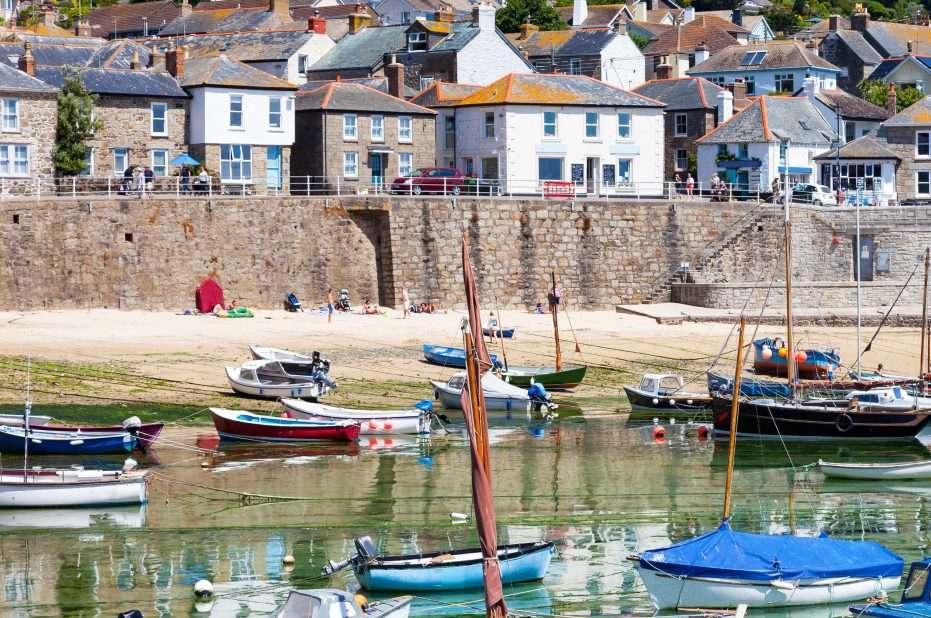
Mousehole Harbour – A History
Mousehole, tucked away in the shelter of the western end of Mounts Bay, was described by playwright Dylan Thomas as “the loveliest village in England”; it remains so, a picturesque Cornish harbour once home to a vibrant fishing fleet.
Mousehole is very much on the tourist trail, and rightly so; with all its charm though comes a long and fascinating history.
The first definitive records of the village are from around 1267 when it appears to have been the most important fishing port in Mounts Bay. It was known as Porth Enys: “port of the island”, which is assumed to refer to St Clements Isle which sits a few hundred metres off the harbour and is very often home to a colony of seals soaking up the sun. The Isle itself was named after a hermit, who lived on the island, there was once a small chapel too, but this no longer remains.
As early as the 14th century, pilchards were being exported to France from Mousehole; the fishing fleet at that time, dwarfed those of larger neighbours Newlyn and Penzance.
Pronunciation of Mousehole
Important to the history of Mousehole harbour is how to say it’s name, not one to get wrong if you are visiting! The correct way to say Mousehole is ‘Mowz-ul’; note though there is a shop in the village called “The Mousehole”, that should be pronounced as you read it!
The first mention of ‘Mousehole’ comes in 1283, but the origins of the name are unclear. One possible source is the large sea cave just beyond the village where smugglers are once reputed to have stashed contraband. There is a wonderful conspiracy theory that a secret passageway runs from this cave up to Carn Du, a stunning Edwardian Villa (see details of the property on this website, why not book and see if you can find the infamous tunnel!!) Another possibility is that Mousehole is actually a Saxonised version of the older Cornish place name ‘Moesyhale’, meaning ‘young woman’s brook’. This would make sense, given that the 14th century marked the beginning of a decline in the number of native Cornish speakers and the steady encroachment of English. The other, most popular suggestion is that it is taken from the appearance of the original harbour entrance. No one really knows, so choose your favourite!

The Spanish Invasion
On the morning of 23rd July 1595, four Spanish galleons appeared off the coast of Mousehole. Led by Carlos de Amesquita, a raiding party of Spanish soldiers came ashore in west Cornwall and attacked the settlements of Mousehole, Paul, Penzance and Newlyn. The attack was part of the conflict between Catholic Spain and Protestant England. Mousehole was also bombarded from the sea, the devastation was wide spread with virtually every house in the village damaged, with many burnt to the ground, Extraordinarily only 3 men were killed, one of which was the Square Jenkyn Keigwin, who was killed by cannonball whilst defending his iconic building, which incidentally was the only building to escape damage. The building, still in existence is called the Keigwin Arms, is a distinctive Tudor building, with its two granite pillars, it is the oldest remaining building in Mousehole. Next to the entrance is a plaque commemorating the death of Squire Keigwin.
After destroying Mousehole, they went on to burn down nearby Paul church and raise Newlyn to the ground.

Tom Bawcock
Mousehole, a sleepy Cornish village for much of the year, becomes a must-visit, bustling centre of Christmas joy over the festive period, resplendent with Christmas lights and lanterns. There is a story behind these now famous Mousehole lights and that is of Tom Bawcock and his trusty cat.
He appears to have been a local fisherman in the 16th century. According to the legend, one winter had been particularly stormy, meaning that none of the fishing boats had been able to leave the harbour. As Christmas approached, the villagers, who relied on fish as their primary source of food, were facing starvation.
The story goes that Tom Bawcock decided to brave the storms and set out in his little fishing boat, accompanied by his cat ‘Mowzer’. Despite the stormy weather and the difficult seas, he managed to catch enough fish to feed the entire village, if you like a fairy tale the success of the catch is down to his cat, who’s singing soothed the storm.
On returning to the harbour, the storm blew up again and the skies turned black leaving Tom and Mowzer unable to find their way home. The villagers came to their rescue by lining the cliffs holding lanterns to guide the saviours home.
The entire catch (including seven types of fish) was baked into a pie, which had the fish heads poking through the pastry, gazing at the stars, to prove that there were fish inside. Since the 1950s, Tom Bawcock’s festival has been an annual event held on 23rd December. The celebration and memorial to the efforts of this local hero sees the villagers parading a large stargazy pie during the evening with a procession of handmade lanterns, before eating the pie itself.
The Christmas lights each year celebrate this story with strings of lights lining the streets and numerous lanterns including a large cat and giant stargazy pie! The whole story is immortalised in the famous childrens book “The Mousehole Cat” by Antonia Barber.
The Penlee Lifeboat Disaster
Unlike the story of Tom Bawcock, real life tales of the sea do not always end happily and this is painfully true of the Penlee Lifeboat, Solomon Browne, which is a crucial part of the history of Mousehole harbour.
The Union Star was on her maiden voyage, sailing from Holland to Ireland with a cargo of agricultural fertiliser. As well as Captain Henry Morton and his crew of four, she carried the captain’s wife and two teenage stepdaughters, who had joined the ship so that they could be together for the holidays.
At 6pm on 19 December 1981, disaster struck. The Falmouth Coastguard received a call from the Union Star: her engines had failed and would not restart. There was a fierce storm underway and the heavy seas and hurricane force winds were blowing the coaster towards the treacherous Cornish coastline.
A Sea King helicopter was scrambled from RNAS Culdrose and attempted to lift the crew off the ship but the coaster was rolling and pitching on the wild seas, so violently that her mast threatened to collide with the helicopter overhead. The aircrew had to abort the rescue as the mast was too close and their line not long enough to reach the deck from further away.
The coaster had drifted to just 2 miles from the perilous coastline, so the Solomon Browne was finally launched, 2 hours after the first alert. Rumour had spread in Mousehole that the lifeboat may be required so Coxswain William Trevelyan Richards had already chosen his top eight men from the twelve who had answered the call.
The helicopter stood by as Penlee’s lifeboat, a wooden 47ft (14.3m) Watson class, launched in the hurricane force 12 wind, fighting against 90-knot winds and 18m waves. The Solomon Browne struck against the side of the coaster and the lifeboat crew stood against the railings, throwing lines across to the coaster. After a valiant battle, lasting around half an hour, the crew managed to get four off the Union Star onto the lifeboat. They radioed back to the Coastguard: ‘we’ve got four off’ and the helicopter turned back to base, assuming the lifeboat would head to shore.
But the lifeboat decided to make a final rescue attempt – and after that point, all radio contact was lost. The Coastguard radioed back to the lifeboat, but there was no response. Ten minutes later, the lights of the Solomon Browne disappeared. The helicopter refuelled and launched once more. Lifeboats from Sennen, The Lizard and St Mary’s on the Isles of Scilly were sent to help their colleagues, but their searches were unsuccessful.
At daybreak, the Union Star was found capsized on the rocks by Tater Du Lighthouse and wreck debris from the lifeboat began to wash ashore.
The disaster inspired a public appeal for the village of Mousehole, which raised over £3 million – the equivalent of £10 million by today’s standards. Lieutenant Commander Russell Smith, the pilot of the Sea King helicopter, recounted:
‘The greatest act of courage that I have ever seen, and am ever likely to see, was the penultimate courage and dedication shown by the Penlee [crew] …
‘They were truly the bravest eight men I’ve ever seen, who were also totally dedicated to upholding the highest standards of the RNLI.’
Every year on 19 December, the Christmas lights at Mousehole are dimmed between 8 and 9pm in memory of the 16 people who lost their lives, leaving just the Cross and Angels shining down across the village and out to sea.

I am sure you will agree, for a small, quiet, beautiful harbour village, Mousehole Harbour certainly has its fair share of history. I encourage anyone visiting West Cornwall to head to Mousehole, just a couple of miles along the coast from Penzance and spend the morning wandering these historic streets. Stop for some lunch at the many lovely eateries (more on that in the next Journal) and then walk back to Penzance along the coast via the equally historic harbour of Newlyn.
Immerse yourself in the charm of Mousehole, Come and Stay!
Mousehole Cottage
A lovely detached Cornish Cottage, tucked away, close to the heart of beautiful Mousehole Harbour. Benefits from wonderful sea views, a private parking space (gold dust in Mousehole!), a fully secure garden, wood burner and central heating for the chillier evenings, well equipped kitchen and comfortable living area. Sleeps 6 in 3 bedrooms, very dog friendly.
The Summer House
Stunning detached property set above the beautiful village of Mousehole, spacious and stylish interior, private garden, and parking for 2 cars. Large master suite, with fabulous shower room and patio doors to garden, a further family suite with ensuite bathroom and patio doors out to a balcony overlooking the swimming pool and garden. Sleeps 6 (max 4 adults), dog friendly.
Book your stay today and soak up the varied history of Mousehole Harbour first hand.
Please email or call me for more details.
Phay
07798 624214
